
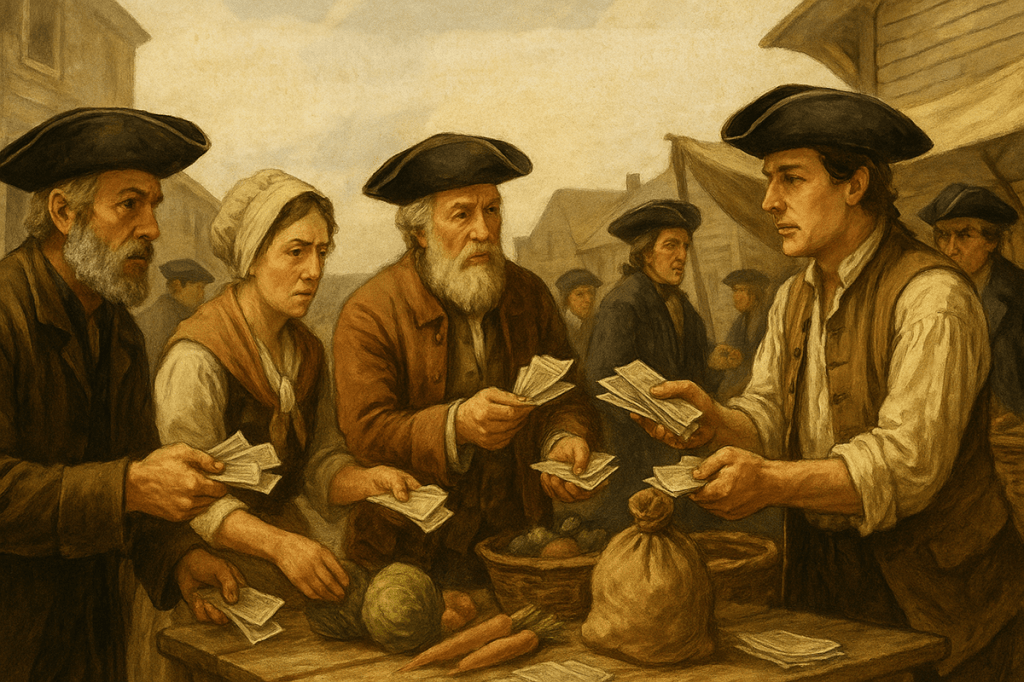
Inflation is not just a modern complaint. In October 1775 it was already squeezing every family in Norwich and across New England. People felt it in their purses, in their kitchens, and in the taverns. Congress had begun printing paper money to pay soldiers and keep the cause alive, but the more notes they issued the less anyone trusted them. Unlike hard coin, these bills were not backed by silver or gold. They were promises, and promises could not be melted down or traded across the sea. The shopkeepers and merchants knew it. They raised prices to protect themselves, asking for more paper for the same flour, butter, or salt. Families discovered that a shilling no longer bought what it did in the spring. A Norwich housewife carried home less bread, less sugar, and less cloth, and she paid more to do it. Farmers shook their heads, muttering that Congress’s money was not worth the ink.

The problem was made worse by the blockade. The Royal Navy tightened its grip on American ports, cutting off the steady stream of goods that had flowed from the West Indies and from Britain itself. Salt, sugar, molasses, iron, and cloth all grew scarce. Rum prices climbed in the taverns as molasses dried up. Blacksmiths and carpenters grumbled about the cost of nails and tools. Housewives stretched meals thinner as butter and flour ate up more of their limited coins. Merchants hoarded what they had and waited for the prices to rise. Patriots cursed speculators who profited while soldiers went without. Every market stall, every workshop, and every hearth was touched by this new kind of battlefield.
While families worried about food and supplies, Congress argued in Philadelphia. On October 4 the delegates spent their time wrestling with how to keep Washington’s army in the field. Enlistments were running out. Pay was uncertain. Discipline was thin. Washington himself kept writing letters begging for money and men, knowing that he could not keep an army outside Boston on speeches alone. Congress promised much, but the men in the tents wanted their wages in something they could spend.
The very next day, October 5, the debate turned from the land to the sea. John Adams and his allies pressed the case for creating a navy. It sounded laughable to some. Britain ruled the oceans with the greatest fleet the world had ever seen. What good could a handful of colonial schooners do? But Adams saw it differently. He knew the British lifeline was their supply ships. Capture a few of those and the army in Boston would starve. By the end of the day committees were forming, regulations were being drafted, and the first outlines of the Continental Navy were taking shape.
And on October 6, Congress looked beyond even ships and regiments. They began talking of secret correspondence, of reaching across the ocean to France and Spain. If this rebellion was to last, it would need allies, money, and gunpowder from abroad. It was an extraordinary step. Only months earlier they had still sent the Olive Branch Petition, begging the King to hear them. Now they were whispering about foreign alliances.
Meanwhile the war itself dragged on. In Boston the siege held, Washington watching Howe, Howe watching Washington, neither side able to strike. In the wilderness, Benedict Arnold had his men hauling bateaux up the Kennebec River, their supplies already spoiling in the rain, their boots sinking in mud, their spirits still hopeful that Quebec could be taken. And across the Atlantic, King George’s ministers polished the words of his speech, preparing to stand before Parliament and brand the colonies as rebels.
Norwich did not need a musket volley to feel the Revolution. It was there in the price of flour, in the shortage of salt, in the rum that cost more in the tavern, in the paper bills that bought less each week. It was there in the voices from Philadelphia, some calling for ships, others for reconciliation, all of them reaching for solutions as the crisis deepened. October 1775 was a month of hunger, arguments, and bold ideas. And it was only the beginning.
 Powder to Parchment
Leave a comment